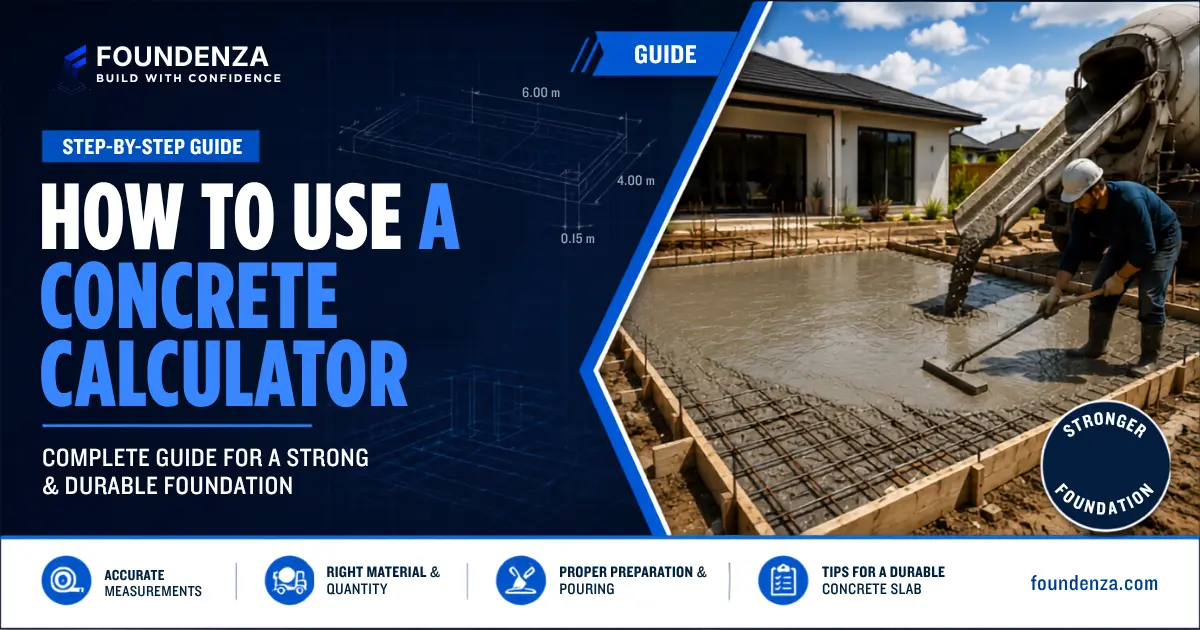

Concrete Calculator
Use the Concrete Calculator to estimate concrete volume, waste-adjusted quantity, approximate weight and pre-mixed bags for rectangular projects.
✓ Accurate estimates♧ Free to use◷ Instant calculation▯ Mobile friendly
Calculation Results
Inputs changed. Calculate again to update these results.
Suggested concrete order
0.00 yd³
Volume Conversions
| Unit | Before waste | Order quantity |
|---|---|---|
| Cubic yards | 0.00 yd³ | 0.00 yd³ |
| Cubic feet | 0.00 ft³ | 0.00 ft³ |
| Cubic metres | 0.00 m³ | 0.00 m³ |
Pre-mixed Bag Estimates
Approximate yields only. Confirm the yield shown on the product packaging.
| Bag size | Approx. yield | Bags required |
|---|---|---|
| 40 lb bag | 0.30 ft³ | 0 bags |
| 60 lb bag | 0.45 ft³ | 0 bags |
| 80 lb bag | 0.60 ft³ | 0 bags |
Calculation Breakdown
- Dimensions
- —
- Number of slabs
- 0
- Volume per slab
- 0.00 yd³
- Waste allowance
- 0.00 yd³
Formula
Volume = length × width × thickness × quantity. The selected waste percentage is then added to the calculated volume.
Estimation Note
Supplier minimums and order-rounding rules may apply. Confirm bag yields and ready-mix quantities before purchasing.
Important: This result is an estimate. Site conditions, measurement variation, spillage and supplier requirements can change the quantity needed.
PDF downloads directly. Print Results opens a separate print-ready report.
Concrete Volume Calculator
The Concrete Calculator estimates how much concrete is required for rectangular slabs, floors, patios, pads, walls, footings and similar projects. It calculates the material volume from the entered length, width and thickness or depth.
The calculator supports Imperial/US and metric measurements. It can also include multiple identical sections and a selected waste allowance. Results include concrete volume, approximate weight and estimated quantities for common pre-mixed bag sizes.
Concrete Calculator Results
The main result is the suggested concrete order quantity after waste has been added. Imperial calculations display the primary quantity in cubic yards, while metric calculations display cubic meters.
The complete results may include:
- Concrete volume before waste
- Additional volume included for waste
- Waste-adjusted concrete quantity
- Volume in cubic yards, cubic feet and cubic meters
- Approximate weight of the required concrete
- Estimated quantities for common pre-mixed bag sizes
The approximate weight is based on an assumed normal-weight concrete density of 2,320 kilograms per cubic meter. Actual density can vary according to the mix design, aggregate, moisture content and intended application.
Concrete Volume Formula
The calculator uses the rectangular volume formula:
Concrete volume = length × width × thickness
If the project contains multiple sections with identical dimensions:
Total volume = volume of one section × number of sections
The selected waste allowance is added to the total:
Order quantity = total volume × (1 + waste percentage ÷ 100)
Calculating Cubic Yards
When length and width are measured in feet and thickness is measured in inches, the thickness must first be divided by 12:
Cubic feet = length in feet × width in feet × (thickness in inches ÷ 12)
Because one cubic yard contains 27 cubic feet:
Cubic yards = cubic feet ÷ 27
Calculating Cubic Meters
Metric dimensions are converted to meters before multiplication. Centimeters are divided by 100, while millimeters are divided by 1,000.
Cubic meters = length in meters × width in meters × thickness in meters
Concrete Calculation Example
Consider one rectangular concrete section measuring 10 feet long, 10 feet wide and 4 inches thick.
Convert the thickness to feet:
4 ÷ 12 = 0.3333 feet
Calculate the volume:
10 × 10 × 0.3333 = 33.33 cubic feet
Convert the result to cubic yards:
33.33 ÷ 27 = approximately 1.23 cubic yards
Add a 10% waste allowance:
1.23 × 1.10 = approximately 1.36 cubic yards
The suggested concrete quantity is approximately 1.36 cubic yards. A ready-mix supplier may require this amount to be rounded according to its ordering increments or minimum delivery quantity.
Concrete Waste Allowance
A waste allowance helps cover minor measurement differences, spillage, uneven excavation, form movement and variations in the prepared base. An allowance of 5–10% is commonly considered for straightforward projects, but the appropriate percentage depends on actual site conditions.
Accurate formwork on a level base may require less additional material. Uneven ground, uncertain excavation depth, unstable forms or complex placements may require a larger allowance.
Pre-Mixed Concrete Bag Estimates
Pre-mixed bag quantities are calculated using approximate yields for common bag sizes. Imperial estimates may include 40 lb, 60 lb and 80 lb bags. Metric estimates may include 20 kg, 25 kg, 30 kg and 40 kg bags.
Bag quantities are rounded up to whole bags. Actual yield varies by product and manufacturer, so always compare the estimate with the yield printed on the selected packaging.
Important Calculation Limitations
This calculator is intended for rectangular sections with consistent dimensions. Circular areas, columns, tubes, stairs and irregular shapes require calculations suited to their geometry. Sections with different dimensions should be calculated separately.
The result estimates material quantity only. It does not determine concrete strength, structural thickness, reinforcement, joint spacing, footing design or sub-base requirements.
Actual concrete requirements may change because of ground conditions, thickened edges, embedded items, inconsistent excavation, form movement, material loss and supplier rounding policies. Confirm important quantities and structural requirements with the concrete supplier, contractor, engineer or local building authority before purchasing materials.
Frequently Asked Questions
What does the Concrete Calculator estimate?
The calculator estimates concrete volume for rectangular sections. Results include volume before and after waste, unit conversions, approximate concrete weight and pre-mixed bag quantities.
Which measurement units does the Concrete Calculator support?
The calculator supports Imperial/US and metric measurements. Results include cubic yards, cubic feet and cubic meters.
How are cubic yards of concrete calculated?
The calculator multiplies length by width by thickness and the number of identical sections. When the volume is calculated in cubic feet, it is divided by 27 to convert it to cubic yards.
Does the concrete estimate include waste?
Yes. The calculator adds the selected waste percentage to the calculated base volume. The appropriate allowance depends on measurement accuracy, excavation depth, formwork and actual site conditions.
How is the approximate concrete weight calculated?
The approximate weight is calculated from the waste-adjusted volume using an assumed normal-weight concrete density of 2,320 kilograms per cubic meter.
Are the pre-mixed concrete bag estimates exact?
No. Bag estimates use approximate yields and are rounded up to whole bags. Actual yield varies by product and manufacturer, so check the selected product packaging before purchasing.
Can the calculator estimate multiple concrete sections?
Yes. The calculator can multiply the volume by the entered number of identical sections. Sections with different dimensions should be calculated separately.
Can I save or print the concrete calculation?
Yes. Use the available PDF or print option after calculating to save or print the entered measurements and concrete results.